
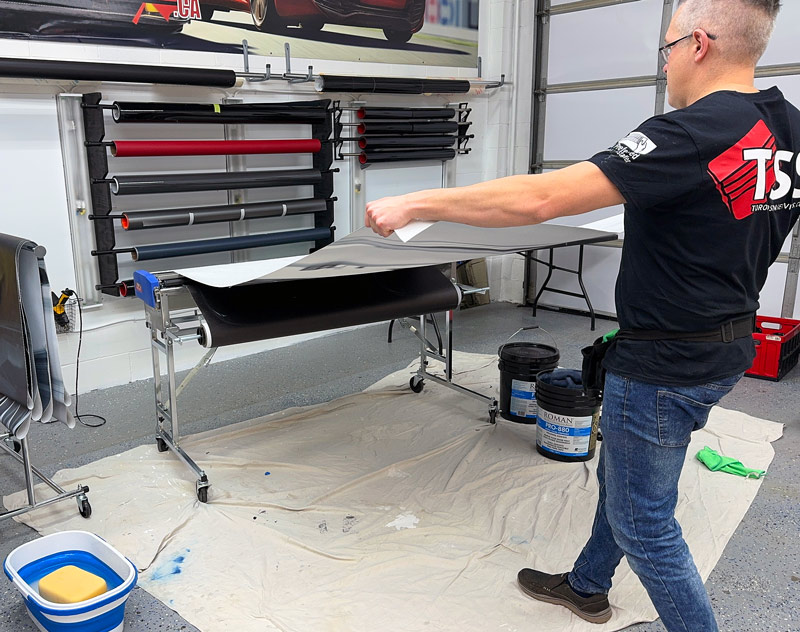
Choosing the right wall mural material isn’t about what looks best on a swatch. It’s about how the wall behaves, what the material is designed to do over time, and how the install method affects seams, finish quality, and project risk.
Below is a practical, printer-and-installer-friendly comparison of self-adhesive vinyl murals (especially premium cast films) versus commercial wallcovering murals (paste-installed wallpaper), using real-world production and installation realities from Toronto/GTA projects.
Premium cast vinyl is typically the safer, faster operational choice for commercial rollouts. Wallcovering is usually the better “interior design” finish when texture and near-invisible seams matter.
1) What these materials actually are
Self-adhesive vinyl mural
A vinyl mural is a printable film with a pressure-sensitive adhesive (PSA). It installs “dry” and bonds by contact, pressure, and time. In the mural world, the key split is cast vs calendered vinyl.
- Cast vinyl (premium): lower internal stress, better dimensional stability, and more predictable long-term behavior at seams and edges.
- Calendered vinyl (economy): can be fine for short-term campaigns, but is generally riskier for long-term murals where shrink and edge stability matter.
Your real-life observation is spot on: premium cast films (e.g., 3M IJ180-class materials) are simply a safer install for long-term mural performance—assuming the wall is suitable.
Commercial wallcovering mural (wallpaper)
A wallcovering mural is typically a heavier substrate (often vinyl-coated or fabric-backed) installed with wallcovering adhesive (“paste”). It’s commonly finished with butt seams (edge-to-edge), and can deliver a warmer, more upscale look—especially when texture is part of the design.
2) Wall surface reality: paint, texture, and moisture
Adhesion is paint-dependent (test first)
Paint chemistry matters. Modern low-VOC paints and “scrubbable” finishes can behave very differently with adhesives. For murals—especially in commercial work—small-scale adhesion testing is a simple step that prevents big failures.
Cure time matters more than people think
“Dry to the touch” does not mean fully cured. Under-cured paint can keep releasing solvents and moisture, which can show up later as bubbles, weak bond, or edge issues. If a wall was recently painted, build cure time into the schedule.
Surface smoothness: vinyl is more demanding
Vinyl is thin and will telegraph imperfections—mud lines, orange peel, patch edges, and texture changes show up in raking light. No special primer is required for vinyl, but the wall must be immaculate and properly cleaned.
Moisture: solve it before either system
Moisture problems (condensation, leaks, envelope issues) must be fixed before installing murals. Wallcovering can slow drying if moisture exists behind the surface; vinyl can also trap issues if the wall isn’t stable. If there’s any sign of moisture risk, address the building condition first.


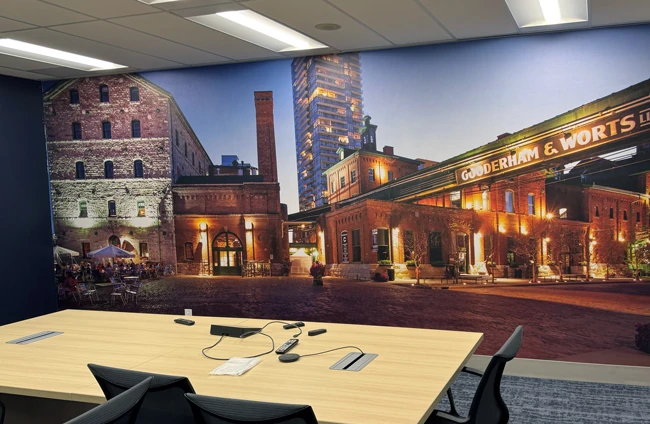
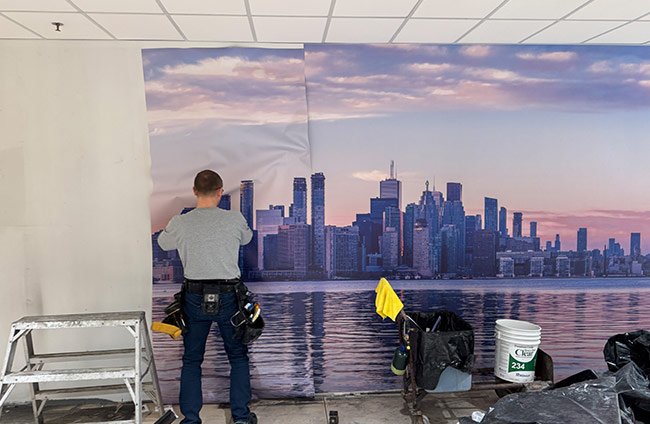
3) Seams and finish quality (this is where results diverge)
Vinyl seams: often overlapped for safety
Vinyl murals are commonly installed with controlled overlaps. It’s fast, forgiving, and reduces the chance that a tiny amount of movement becomes a visible gap. Butt seams are possible (double-cut methods), but they are slower and higher-risk on real walls.
Practical truth:
If the client will judge the mural from 2 feet away in a high-end space, vinyl overlaps may bother them. If it’s a retail rollout or branded interior where speed and repeatability matter, overlaps are often the smarter choice.
Wallcovering seams: cleaner and more “interior design”
Wallcoverings typically use butt seams. With correct prep and technique, seams can be far less noticeable than vinyl, especially on textured substrates and design-forward applications. This is a major reason wallcovering murals read as more “premium.”
4) Prep, install workflow, and jobsite reality
Vinyl workflow (dry install)
- Minimal material mess on site.
- Fast paneling and predictable handling.
- Finish work (trims, corners, obstacles) is where quality is won or lost.
Wallcovering workflow (paste system)
- Requires specific wall preparation and typically a wallcovering primer/sealer.
- Paste handling, seam wiping, cleanup—more steps and more chance for technique-driven defects.
- Overall higher skill requirement (and more “craft time” on the wall).
Your field reality matches what most crews experience: wallcovering is trickier, slower, and messier—yet often worth it for the finish.
5) Real-world economics: material cost, labor, and schedule
Here’s the practical cost and productivity picture you see in real installs:
- Speed: Vinyl is typically ~30% faster. You can install roughly ~1000 sq.ft/day of vinyl vs ~500 sq.ft/day of wallcovering on comparable projects.
- Labor cost: Wallpaper often prices at ~2× vinyl labor (example ballpark: $2/sq.ft vs $4/sq.ft), because it’s slower and more failure-sensitive.
- Material cost: Premium wallcovering can be around $650/roll. Vinyl spans a wide range: cheap calendered may be similar cost (but short life), while a proper cast vinyl system like IJ180 + laminate can be around $2000/roll.
- Consumables: Wallcovering adhesive can add roughly $150 for comparable coverage.
“Vinyl is cheaper” is only true when you compare against economy vinyl. If you spec premium cast + laminate for long service life, vinyl can cost more in materials—but usually wins on speed.
6) Vinyl vs Wallcovering: side-by-side comparison
| Parameter | Self-adhesive vinyl mural (premium cast) | Wallcovering mural (commercial wallpaper) |
|---|---|---|
| Finish / look |
Smooth
Modern
Seams visible close-up Great for branded commercial interiors, but overlaps/butt seams can read “graphic” rather than “decor.” |
Textured
Warm
Premium feel Better interior-design finish; butt seams can be very clean with correct prep and technique. |
| Wall prep sensitivity | Highest for appearance: vinyl telegraphs imperfections. Wall must be immaculate and clean. | Still requires smooth walls, but texture can help hide micro flaws. Primer/sealer is typically part of a correct system. |
| Seam strategy | Overlaps are common for safety; double-cut butt seams possible but slower and more risk. | Butt seams are standard; double-cut methods can produce tight mural seams. |
| Install speed | Faster (dry workflow). Field benchmark: ~1000 sq.ft/day. | Slower (paste workflow + seam finishing). Field benchmark: ~500 sq.ft/day. |
| Jobsite mess | Low. Minimal wet work. | Moderate. Paste handling, seam wiping, cleanup. |
| Material economics | Wide range. Economy calendered can be low-cost/short-life; premium cast + laminate can be high-cost/long-life (~$2000/roll range). | Premium roll pricing often ~ $650/roll plus adhesive (~$150 job consumable typical). |
| Labor economics | Often lower (example ballpark ~ $2/sq.ft). | Often ~2× vinyl labor (example ballpark ~ $4/sq.ft). |
| Durability | Premium cast systems can last 10+ years in controlled interiors. | Commercial wallcovering can also last 10+ years in controlled interiors. |
| Best-fit scenarios | Retail rollouts, branded interiors, commercial campaigns, smooth painted walls, tighter schedules. | Lobbies, feature walls, hospitality/office upgrades, design-led spaces where finish matters most. |
Finish / Look
Great for branded commercial interiors, but overlaps/butt seams can read more “graphic” than decorative.
Better interior-design finish; butt seams can be very clean with correct prep and technique.
Wall Prep Sensitivity
Highest for appearance. Vinyl telegraphs imperfections. Wall must be immaculate and clean.
Requires smooth prep as well. Primer/sealer is typically part of a proper system.
Seam Strategy
Overlaps common for safety. Double-cut butt seams possible but slower and higher risk.
Butt seams standard. Double-cut methods produce tight mural seams.
Install Speed
Faster. Field benchmark: ~1000 sq.ft/day.
Slower. Field benchmark: ~500 sq.ft/day.
Material & Labor Economics
Wide cost range. Premium cast + laminate systems can reach ~$2000/roll. Typical install ~ $2/sq.ft.
Premium rolls around ~$650 + ~$150 adhesive. Install often ~ $4/sq.ft.
Durability
Premium cast systems can last 10+ years in controlled interiors.
Commercial wallcovering can also last 10+ years in controlled interiors.
What to choose: practical guidance for sign shops
Choose premium cast vinyl when:
- You need speed, repeatability, and lower operational risk (multi-location rollouts, retail).
- Walls are smooth, clean, and paint history is known (or you can test).
- The client accepts that seams will be visible up close (especially with overlaps).
Choose commercial wallcovering when:
- The client is judging the wall from close range and wants a high-end interior finish.
- Texture, warmth, and seam aesthetics matter more than speed.
- You can plan proper prep (smoothness + wallcovering primer/sealer) and use a qualified installer.
A simple rule that prevents most mural failures
If you can’t control wall readiness or confirm paint/cleanliness, build testing and prep into the scope. Most mural failures are wall-condition problems—not printing problems.

Need a contractor who can install both vinyl and wallcovering properly?
Toronto Sign Services installs both mural types across Toronto and the GTA—trade-friendly and detail-focused. If you want help choosing material, seam strategy, or planning prep for a specific wall, start here: vinyl graphics installation and commercial wallpaper installation.
Send us the wall photos, dimensions, and timeline and we’ll tell you what to expect—and what to avoid—before you print.